
You can only make an informed decision about whether to keep or sell a piece of jewelry if you can identify what you’re working with. But you may not know how much rubies are worth when you inherit a ruby ring or pull a necklace out of storage. Luckily, it’s simpler than you might expect to estimate that price at home.
Here’s how to find out how much the rubies in your old jewelry are actually worth.
What determines a ruby’s value? 5 features
A ruby’s value comes down to more than how big or bright red it looks. Even the setting and a designer label can add value beyond the stone itself. The following five factors all commonly affect a ruby’s price.
1. Color
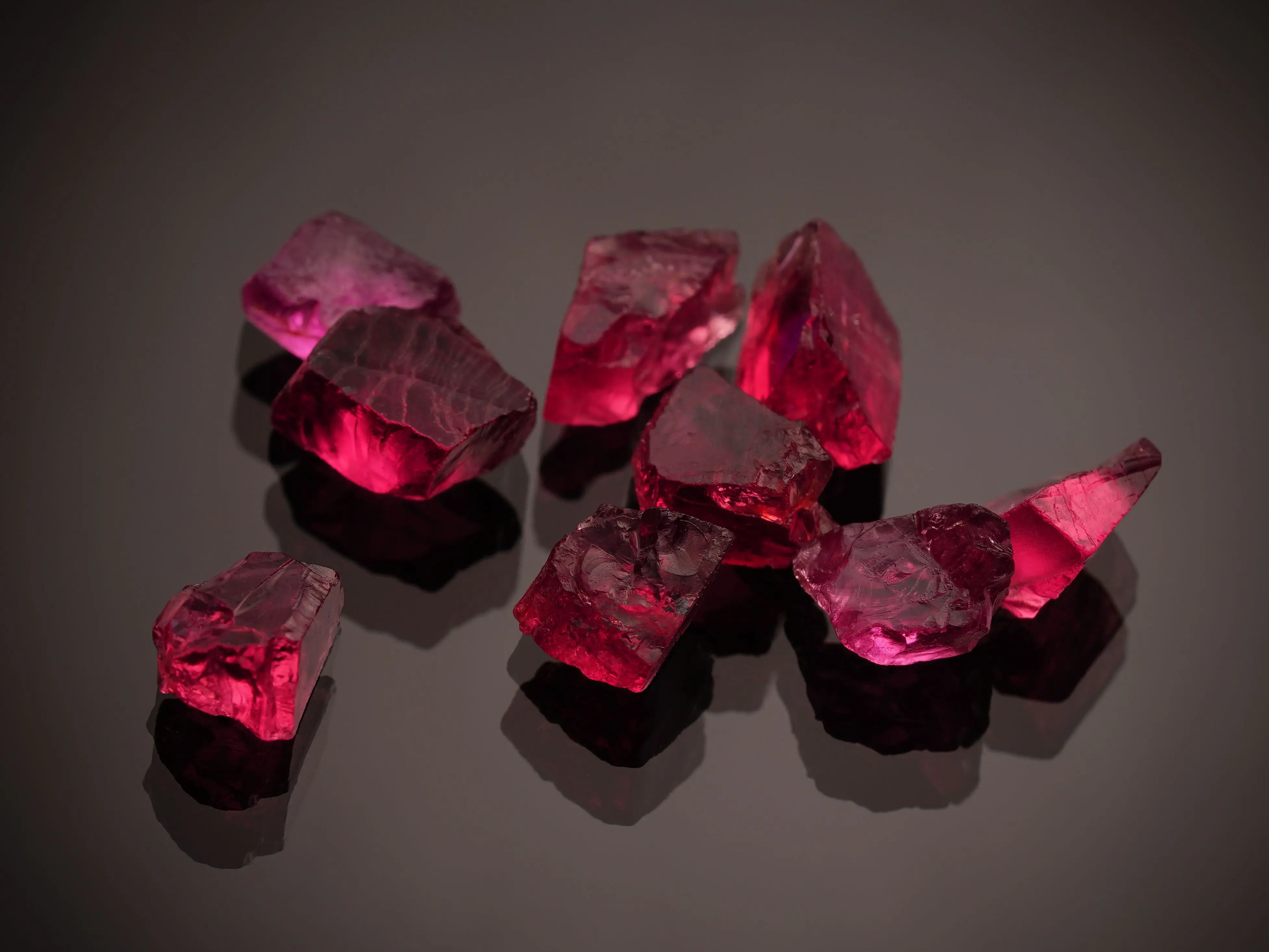
Color is one of the biggest drivers of a ruby’s value. Vivid, strongly saturated red rubies are usually more valuable than stones that look brownish, purplish, or pink. Very dark and very pale rubies also tend to be less valuable than true red ones.
You may hear the term “pigeon blood” used to describe particularly vivid red rubies. While that label indicates it has a highly sought-after color, the description alone doesn’t tell you what a ruby is worth.
Some rubies are also heated to make their color more vivid. These treatments can lower their value compared to stones that are naturally that same color.
2. Clarity
Natural rubies often contain inclusions, or small internal characteristics formed as the stone developed, like fragments of another crystal or hairline fractures. Inclusions that are easy to see or affect the ruby’s transparency can bring its value down.
A clearer-looking ruby can command a higher price, all else being equal. But unlike diamonds, a completely inclusion-free appearance isn’t necessarily the standard you should expect from a natural ruby; a few small inclusions are typical.
3. Carat weight
Carat measures a ruby’s weight, not its dimensions. Size doesn’t always matter, but it influences a ruby’s value much more when it’s paired with strong color and quality. Large high-quality natural rubies are rare, so the price per carat can increase as carat weight goes up.
In other words, a two-carat ruby won’t necessarily be worth exactly twice as much as a comparable one-carat ruby. If their 4Cs are the same, but the one-carat ruby is lab-grown and the two-carat ruby is natural and untreated, the larger ruby could be worth exponentially more.
4. Cut
A good cut makes the most of a ruby’s color, brightness, and overall appearance. A poorly proportioned cut can make an otherwise attractive stone look dark or dull.
The best cuts emphasize the ruby’s color and preserve as much weight as possible from the original stone. Because rubies naturally grow as long, flat hexagonal crystals, oval and cushion cuts are the most valued for showing off a ruby’s natural beauty.
5. Origin
Where a natural ruby came from can affect its market value. Rubies from certain historically important sources — especially Myanmar (formerly Burma) — tend to command higher prices because of their legacy and limited supply.
Origin isn’t something you can reliably determine just by looking at a stone, though. To establish where it came from, you may need the help of a reputable jeweler, valuator (like Unvault), or gemological laboratory (like the Gemological Institute of America [GIA]).
Ruby price per carat by quality tier
The stone is only part of what a ring is worth. The metal, setting, and condition matter too. But if you’re trying to understand the ruby’s value on its own, carat weight gives you a good starting point.
Under one carat
Natural rubies that weigh less than one carat can range from roughly $300 to $7,000 per carat, depending on their quality. Typical commercial stones, like you’d find in box-store jewelry, sit toward the bottom of that range, while vivid red stones with high clarity can reach several thousand dollars per carat.
At this size, color and overall quality tend to matter much more than a small difference in weight.
One to two carats
Once a ruby reaches one carat, there are bigger price swings. Current retail estimates put commercial or included stones around $300 to $1,200 per carat, while clear, vivid examples can reach roughly $15,000 per carat.
Two to five carats
When a stone weighs at least two carats, ruby prices climb sharply. Commercial examples start around $500 per carat, while exceptional stones can reach $80,000 per carat.
Size alone doesn’t create that premium. Large rubies that also have excellent color, clarity, and minimal treatment are rare, so high-quality features compound their value.
Over five carats
Natural rubies over five carats span an enormous market. Commercial stones can sit around $1,500 to $10,000 per carat, while exceptional examples can reach over $200,000 per carat in the retail market.
At this scale, smaller details like documented origin and whether the stone is heated become especially important. An independent lab report can help you establish those characteristics so you’re not left guessing based on its appearance.
What natural vs. lab-created means for value
Natural and lab-created rubies are essentially identical on a chemical level. But when it comes to value, there’s a major difference: Natural rubies are scarce, while lab-created rubies can be produced at volume under controlled conditions.
Natural rubies
Natural rubies form in the earth, which makes rarity a major part of their value. Their price depends on the same factors we’ve already covered. Lab rubies are more likely to have high clarity and uniform color, but natural rubies’ imperfections also mean higher quality stones are worth significantly more.
Small and lower-quality natural rubies may be worth hundreds of dollars per carat, while large, exceptional stones can reach tens of thousands (sometimes considerably more) per carat. Natural rubies also carry meaningful resale value, although what you can actually sell one for may be very different from its retail price.
Lab-created rubies
Lab-created rubies are real rubies in the chemical sense: They have essentially the same physical and optical properties as natural stones. The difference is where and how they formed.
Because manufacturers aren’t limited to what’s minable and can produce them at will, lab-created rubies generally cost far less. They also aren’t treated as a resale asset in the same way natural stones are, because it doesn’t take much to recreate a lab ruby exactly.
If you want to understand a ruby’s value, establishing whether it’s natural or lab-created should be one of your first steps.
See what your ruby could be worth with Unvault
You don’t need to know everything about rubies to make an informed decision about what to do with yours. Color, cut, clarity, size, origin, and treatment can give you a sense of its potential worth, but a valuation can turn those clues into a number that’s actually useful.
If you’re considering selling jewelry online (or to a local reseller), Unvault gives you a way to find out what your natural ruby is worth before you commit to selling it. Upload a few photos to get general information in seconds, or send in your jewelry for free using a provided shipping label for more information. Unvault records the appraisal process so you can see how your piece is evaluated and understand how we came to our answers.
Once you have an offer, you can accept it or get your piece mailed back, whether you want the ruby to stay in the family or sell it somewhere else.
Get your instant valuation from Unvault today.
Frequently asked questions
Know what your jewelry is worth before you sell.
Monthly gold-price context and hallmark guides from Unvault’s gemologists. No spam, unsubscribe anytime.
Related posts
.webp)
Ready to see what your jewelry is worth?